



 |
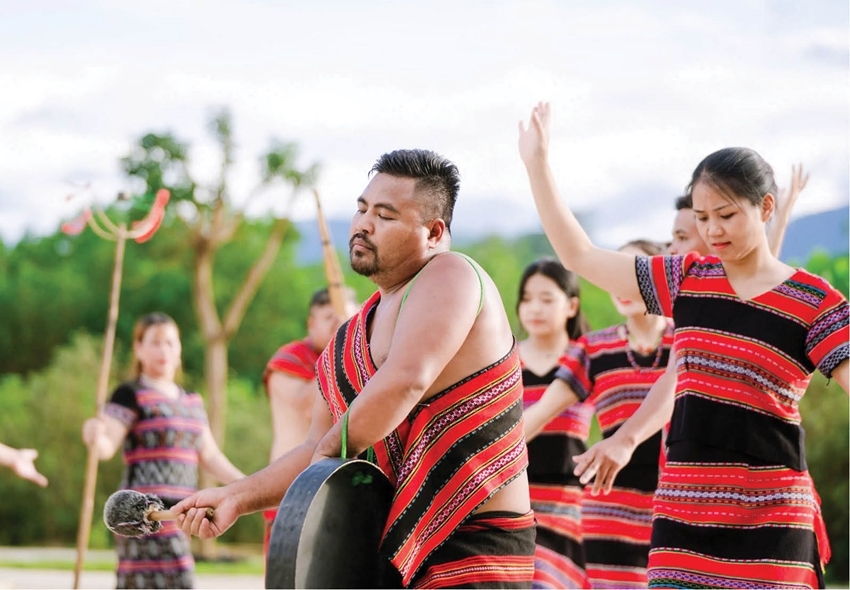
| Nguyen Xuan Bay immersed in a performance |
Each time he took part in village, communal, or district festivals, Bay’s hands became more skillful on the gongs, his drumbeats louder and steadier; his khen and horn sounds grew ever more refined. He recalled that when the late elder Co Dac of Hong Van commune (now A Luoi 1) was still alive, whenever he struggled with something during his self-study, he would run to the elder’s house for guidance. “Now that the elder passed away, I feel as if I’ve lost a teacher, a guiding flame.”
“I can play five instruments: the gong, drum, khen, cymbals, and horn, but the gong and khen are my best,” Bay said enthusiastically. To him, the gongs and drums are more than musical instruments. They embody the spirit of the festival, the voice of the mountains and forests. “In an ensemble, the gong, drum, and khen must harmonize perfectly for the young men and women to dance. Without those sounds, the festival would lose half of its joy.”
Since his youth, Nguyen Xuan Bay has often been invited to perform at cultural events. Whether it was the village’s new rice festival, a commune or district performance, or a provincial delegation of artisans representing their culture, his name was always on the list.
He recounted that during the Lunar New Year of 2025, he and his art troupe traveled to Ho Chi Minh City to perform at the event “On the wharf, in the boats,” bringing the sounds of Pa Co gongs and khen to introduce to southern audiences. “People from the lowlands were amazed when they heard them,” he recalled proudly. “They said those sounds seemed to carry the entire vast forest down into the city.”
Most of the roles Bay performs on stage are those of the village elder. Amid the rhythm of drums and gongs, he becomes the leader who reminds young men and women to preserve their customs and obey the law, urges youth to work diligently, and advises married couples to respect family values. Through songs and dances, those messages are conveyed gently yet profoundly to the younger generation.
Behind his passion for culture lies a life full of hardship. His father passed away early, and his mother remarried, so he and his siblings grew up relying on each other. Now that though having children, he and his wife have no farmland in the highlands and mainly make a living as construction workers. When there’s work, he goes; when there isn’t, he practices for upcoming performances. “Sometimes I play gongs or the khen without any pay,” he said with a gentle smile. “But I love it, I’m passionate about it, so I go anyway. My wife and kids understand and support me.”
Over the years, the authorities of the former Hong Bac commune have repeatedly commended Nguyen Xuan Bay for his enthusiasm and dedication to cultural and artistic movements. To the villagers, he is a true “artisan”, a guardian of the fading sounds of the khen and the drum.
Artisan A Deng A Teng, an expert in Pa Co gongs and drums, remarked that Bay’s horn sound is exceptional. During festivals, the echo of his horn resonates through the mountains and forests, a call that gathers children and grandchildren home. That sound, he said, fills the village air with joy and togetherness.
When we had an appointment with him, Nguyen Xuan Bay had just returned from a cultural exchange program at the Vietnam National Village for Ethnic Culture and Tourism in Dong Mo, Hanoi. It was an opportunity for him to carry the sounds of his gongs and khen from Ra Looc - A Soc to a wider audience, helping to promote the traditional culture of his people both at home and abroad. “Every time I perform far from home, I feel so happy,” he said eagerly. “It’s not only about my experience, it’s about bringing my highland village closer to many others.”
Mrs. Le Thi Them, former Head of the Department of Culture, Science and Information of A Luoi District (now Head of Party Affairs at A Luoi 1 Commune), shared: “Amid the busyness of life, people like Nguyen Xuan Bay are truly precious. He continues to sow the melodies of tradition into community life with quiet devotion. It is thanks to such silent hearts that highland culture endures, so that the sounds of gongs and drums may continue to echo through the vast mountains.”