



The session also served as a multidimensional discussion among administrators, experts, and UNESCO representatives, reaffirming the pioneering role of heritage cities in exploring new development models: harmonizing conservation, innovation, and the enhancement of residents’ well-being.
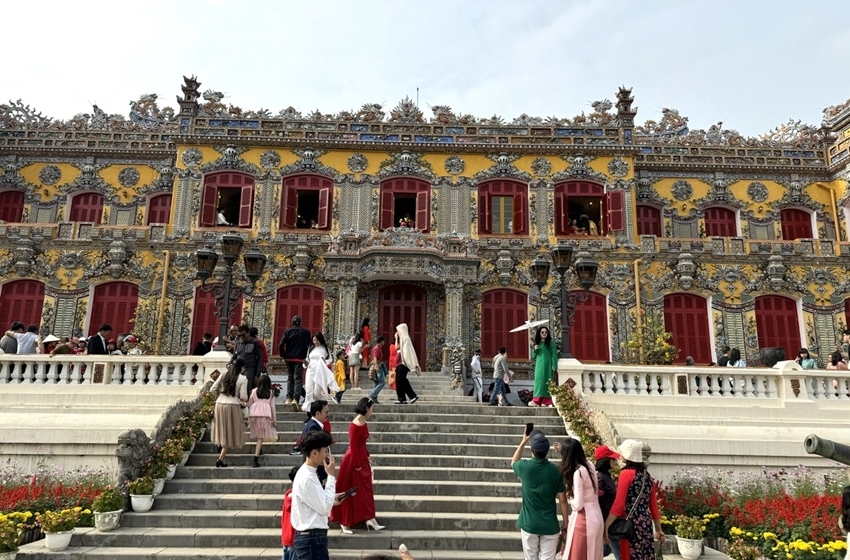 |
| Kien Trung Palace is a model of heritage conservation and development in Hue |
People are the center of heritage development
Opening the discussion, Dr. Ang Ming Chee, Executive Director of George Town World Heritage Incorporated (GTWHI, Malaysia), shared the experiences of George Town and Melaka - two historic cities recognized by UNESCO as “outstanding examples of cultural exchange between East and West”. She emphasized that the greatest challenge today is not merely preserving ancient architecture, but maintaining the connection between the community and its heritage, ensuring that people feel they are both owners and co-creators of local identity.
Through the “Heritage by the community, for the community, and with the community” model, GTWHI has organized hundreds of consultation activities, educational programs, and heritage festivals - fostering a vibrant, community-driven spirit from within society. Dr. Ang also proposed the establishment of a Global Network of World Heritage Managers to connect, exchange, and share experiences among heritage cities, thereby strengthening the capacity and voice of heritage managers within the UNESCO system.
From a coordinating perspective, Dr. Phan Thanh Hai stressed: “Heritage cannot be protected without social consensus. The participation of the community - from local residents and businesses to scientists and international organizations - is the key factor ensuring the sustainability of heritage cities”. This viewpoint became the conceptual thread running through the entire discussion, linking seemingly different topics into a unified theme: People are at the center of heritage development.
Digital heritage and smart cities
 |
| Delegates participating in group discussions and a Q&A session during the workshop |
Dr. Hong Seung Mo (South Korea) delivered a comprehensive presentation on “Prospects of Information Technology in the Conservation, Management, and Revitalization of Heritage Cities,” based on UNESCO’s framework. He affirmed that digital technology is a strategic lever for strengthening the resilience and sustainability of heritage, especially as cities face natural disasters, climate change, and tourism pressures.
Modern technologies now allow for accurate recording, reconstruction, and management of urban historical layers. The 3D scanning project of Thai Hoa Palace in Hue has developed an integrated model combining structure, chronology, materials, and metadata, paving the way for the comprehensive digital conservation of the Hue Imperial Citadel. This stands as a prime example of the transition from “physical conservation” to “digital heritage management”. Hue is advancing toward a “Digital Heritage - Smart City - Sustainable Community” model, where technology does not replace humans but rather serves them, preserving the humanistic values of heritage while enhancing quality of life.
Assoc. Prof. Dr. Kim Ji-hong (Hanyang University, South Korea) further deepened the social dimension of heritage conservation. She pointed out that in many Asian countries the conflict between heritage conservation and economic development remains a difficult problem. She argued that when local authorities tie conservation to improving residents’ living standards, heritage is no longer seen as a “development barrier” but becomes a resource that stimulates local cultural and economic activity.
A new legal framework and opportunities for Vietnam’s heritage
 |
| Tourists visiting Hue Imperial Citadel |
From a policy perspective, Dr. Le Thi Minh Ly, Vice President of Vietnam Cultural Heritage Association, cited the Cultural Heritage Inventory Project in Hue as a large-scale initiative, the first to compile and identify more than 800 monuments, nearly 600 intangible heritages, and hundreds of rare documentary heritages. Dr. Ly affirmed: “Only with complete, transparent, and up-to-date data can we manage heritage through knowledge instead of mere intuition”.
Through the discussion, it became clear that from Malaysia and South Korea to Vietnam, three major schools of thought on heritage management converged in Hue. These are: Community - Heritage truly “lives” only when the community jointly protects and co-creates it; Technology - Digital transformation is a powerful tool to understand, document, and revive heritage; Policy - Law form the framework ensuring sustainable, balanced development between conservation and daily life.
The discussion session wove these perspectives into a harmonious whole, where experts agreed that heritage is not only a legacy of the past but also a resource for future development, if placed in its rightful position within social and policy structures. That also reflects the spirit of Hue today - a heritage city in dynamic transformation, striving to become a creative, smart, and humane city in the new era.
 |
| Hue’s urban heritage stands as a model for heritage cities across the Asia–Pacific region |
The session not only carried academic value but also served as proof of Hue’s proactive role within the global network of heritage cities. The exchange of ideas was tightly connected, moving from theoretical discussions to practical applications. International experts highly appreciated Hue’s balanced approach that integrates heritage conservation, smart tourism, and digital transformation, viewing it as a “regional model” that could be replicated in other heritage cities across the Asia-Pacific.
From George Town to Gyeongju, from Hahoe to Hue, each heritage city is seeking its own answer to the challenge of “conservation within development”. Yet this session revealed a shared direction: Connecting knowledge, technology, and community to build sustainable and livable heritage cities.
As Dr. Phan Thanh Hai concluded in his role as session moderator: “Preserving heritage is not about closing the past, but about opening the future. When heritage becomes a living part of modern life, when people truly benefit from their own heritage, that is when we achieve genuine sustainable development”.