



Along the garden paths, children’s cheerful voices mingle with the calls of harvesters, evoking a vivid picture of daily life beneath the rooftops of old Hue.
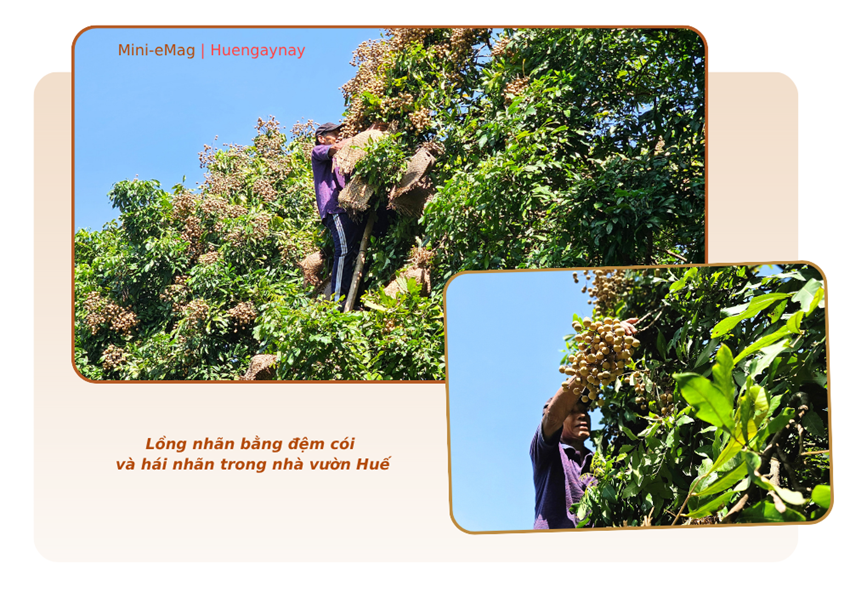 |
| Longan harvesting at many households |
Joyful houses, bustling markets, fragrant roads
At the junction of the road to the Van Thanh (Temple of Literature) relic site stands a longan tree so heavily laden with fruit that it draws admiring remarks from every passerby. According to its owner, Mrs. Nguyễn Thi Xi, the tree was planted by her father over 40 years ago to provide shade beside the house. This year’s bumper harvest sees every branch thick with clusters of fruit. Moreover, it is a “ráo” (firm-fleshed and less-juicy) longan variety, with thick flesh and small seeds, so when the fruit reaches peak sweetness, her family harvests it gradually for sale.
“We have to pick and sell them before the rainy season to keep the longans from splitting and to stop bats from eating them. I take them to sell near Thien Mu Pagoda (Pagoda of the Celestial Lady) for 25,000 dong per kilo. After a few rounds of harvest, the tree has brought in millions of dong — more than in previous years,” Mrs. Xi said proudly.
Across the Huong (Perfume) River, early in the morning, the Nguyen Van A family on Bui Thi Xuan Street busied themselves with the longan harvest. The 70-year-old tree, planted by Mr. A himself, now casts its shade over part of the roadway, so he had to arrange for the picking to start early to avoid busy traffic. One person handled the ladder, another watched for passing vehicles, another carried the sacks, and another weighed and divided the fruit. Everyone was eager to gather and enjoy the taste of their homegrown longans. That is why Mr. A turned down offers from traders to buy the tree for millions of dong.
“I planted this longan tree myself; it is just a few years younger than I am, so I think of it as a friend of the family. It fruits only once every two years, and harvest time is also a reunion for children and grandchildren; neighbors stop by to admire the fruit, and the whole day brims with cheer,” Mr A said with a satisfied smile.
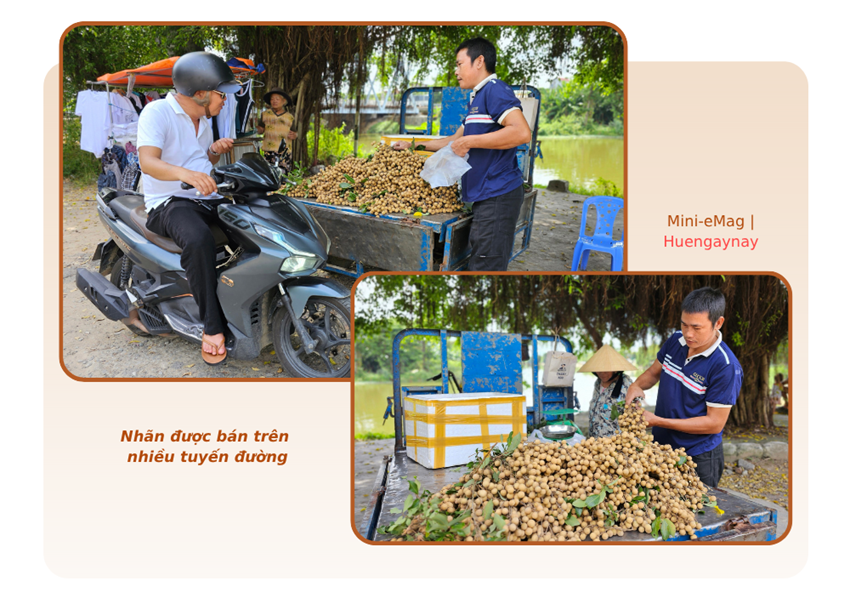 |
| Tourists savouring Hue longans by the roadside |
In late July and early August, Hue longans can be found everywhere — in markets, along the streets, and along the entire route inside the Imperial City, seemingly infused with a gentle, sweet fragrance. Due to high labor costs for wrapping the fruit or significant profit-sharing arrangements, many households choose to harvest the crop as soon as it reaches a sweet-enough ripeness. Depending on quality, Hue longans sell for 15,000–30,000 dong per kilogram on the open market, while netted ones fetch 50,000–100,000 dong per kilogram. During the longan season, many fruit shop owners post regular updates on their fan pages to advertise the fruit. According to the owner of a stall in Thuan Hoa Ward, there are days when she sells 100 kilograms yet still cannot meet demand, as local longans are naturally fragrant and sweet, grown without fertilizers or chemicals.
This year, Mr. Duong Van Loi, who specializes in buying longans, has been busy wrapping and harvesting longans. With nearly four decades of experience, he has leased orchards having as many as a thousand wrapped bunches. “Dai Noi (Imperial Citadel) longans have long been famed for their taste,” he said. As the old saying goes, “Trang Lychees from the Cung Dien area; spathe-wrapped longans from Phung Tien, a former royal garden district”— a tribute to royal delicacies. Some trees yield thick-fleshed, small-seeded fruit with an unmatched fragrance—true imperial longans.”
On Dang Thai Than Street, behind the Hoa Binh (Peace) Gate of the Hue Imperial Citadel, stands a longan tree that is special among many in the neighborhood. The house is inhabited by a descendant of a mandarin from the Nguyen era. The tree, roughly one hundred years old, bears large, thick-fleshed, and fragrant fruit. Although it is not wrapped, the fruit is still flavorful, said to be a variety brought out from inside the royal palace. “Every harvest, we carefully climb the tree to pick the fruit, which sells for 80,000 to 100,000 dong per kilogram,” Mr. Loi added.
Who remains nostalgic for the areca spathe–wrapped longans?
Hue longans hold little economic worth because growers primarily plant them for shade. The season means more than just sweet fruit; it is a season of memories. The renowned longan stuffed with lotus seeds from renowned Tinh Ho Lake (Lake of Serene Mind) has become scarce. The craft of wrapping longans in areca spathe, once widespread, now lives only in memory.
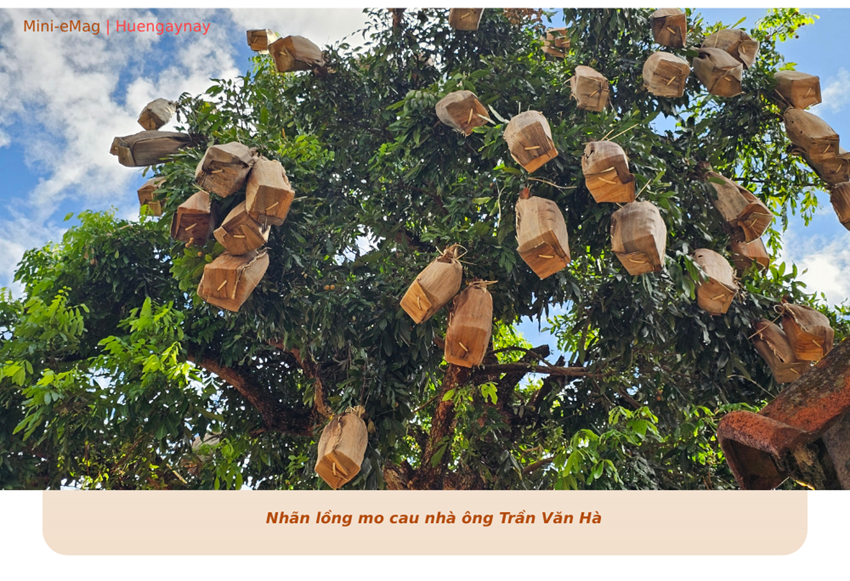 |
| A rare areca spathe-wrapped longan tree today |
I have met several who inherited the craft of wrapping longans into the second and third generations. In their memories, the lively footsteps still echo as they recall old My Loi, carrying bundles of areca spathes through the shimmering waterways at sunset. It is the image of carrying packed rice through the ancient longan orchards of Kim Long, where the aroma of fruit mingles with the scent of earth, and the sound of cicadas blends with people’s calls. Time has changed many things, and this craft is no exception; the old longan orchards are gone, and people have left the craft due to life’s burdens.
These days, every morning, Mr. Tran Van Ha, 82, from Bang Lang Hamlet, former Thuy Bang Commune (now Thuy Xuan Ward), takes a walk ahead of his house, where a longan tree laden with areca spathe wrappings sways in the wind. Many neighbors, on their way to breakfast nearby, stop by to admire Mr. Ha’s “areca spathe lanterns” and exchange a few words. Decades ago, wrapping longans in areca spathes was not unfamiliar to residents of the Tuan junction area, where the Ta Trach and Huu Trach Tributaries (Left and Right Tributaries of the Perfume River) meet. This style of wrapping seems to have faded away over the last thirty years; yet today, the scene is revived at Mr. Ha’s house.
The longan tree wrapped in areca spathes has attracted many unfamiliar visitors to Mr. Ha’s home, simply because it evokes childhood memories for many people in Hue. Ms. Ho Thanh Hien, who often stops by during her morning bike rides, recalled: “As a child, I frequently helped my father wrap longans in areca spathes for others. Those were hard, unforgettable days, but this craft helped my family earn extra money to buy rice. Because of that, I learned that longans facing east are always sweeter and more fragrant, as they receive more sunlight.”
Among Mr. Ha’s longan trees, one is roughly 50 years old while the other is about 70. The 50-year-old tree is of ráo longans, prized for their aroma and flavor; thus, he insisted on hiring experienced workers to wrap the fruit in areca spathes. Having worked in this craft since he was 20, Mr. Ha believes that longans wrapped in areca spathes stay cooler than those wrapped in sacks, and the fruit looks smoother, shinier, and juicier. Every two areca spathes form a wrapping that holds about 0.5–0.7 kg of fruit. It takes one worker around five days to complete about 200 such wrappings on a single tree, from preparing the materials to weaving areca spathes and wrapping the fruit.
Mr. Tran Van Dieu, 46, was handpicked by Mr. Ha for his skilled hands that consistently wrap hundreds of longan clusters with precision. Since childhood, he followed his father and grandfather harvesting areca nuts, picking longans, and climbing coconut trees. Now, he earns a living from agarwood production. He only takes on longan wrapping and selling jobs when there is demand, as he is getting older and needs stable work to support his two school-age children.
For decades, he hadn’t used areca spathes to wrap longans because the process is very painstaking. The leaves must be carefully selected—large and thin—soaked to soften, pierced, split into strips, bent, and woven into round shapes. This time, he “broke tradition”, partly out of respect for the growers’ devotion, and partly to create a unique “work of art” for the younger generation to admire the craftsmanship of bygone days. “Many ask how much I get paid for such meticulous work. Actually, the harvest share is agreed upon. It’s laborious but enjoyable, because it’s done properly, just as my grandfather used to do,” he said with a rustic smile.
“Rain at the right time makes the longans grow large, juicy, and sweet.“Longans in areca spathes—to savor every bite,” his voice echoed through the orchard like the final note of a fading craft.
Just a few days away, the areca spathe-wrapped longans will begin to be harvested. Hundreds, even thousands, of other longan trees throughout the Ancient Capital will also enter their final picking stage before the long rainy season sets in. Another longan season draws to a close, carrying the memories of Huong Ngu residents so that whenever they recall those times, the sweet fragrance of longans on the veranda still drifts softly on the breeze.