



 |
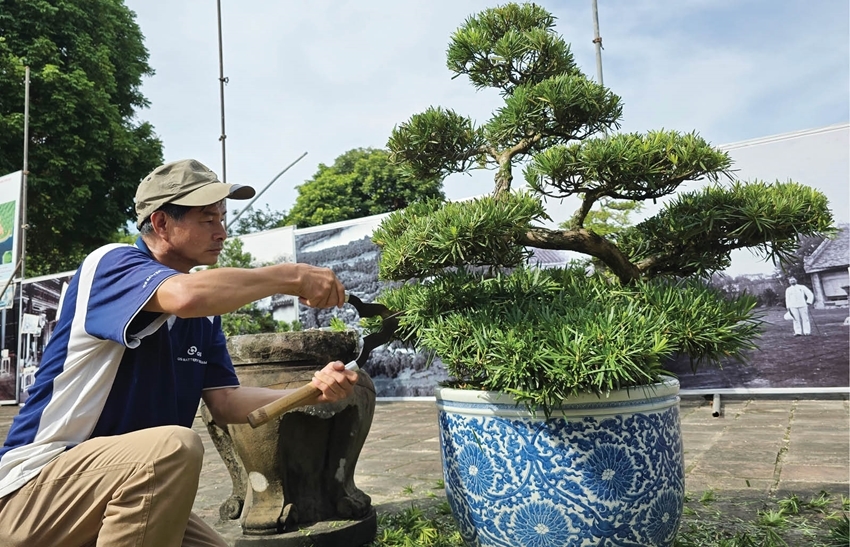
| Tending and shaping ornamental plants at heritage sites |
Caring for every leaf
In the sweltering July sun, along the path to Thieu Tri’s mausoleum, Nguyen Van Tuan, head of the landscaping team under the Landscape and Environment Department of Hue Monuments Conservation Center, takes a short break with colleagues under a tree after trimming the massive canopies of ancient trees.
“The trees inside relic sites like The Mieu, Trieu Mieu, and the tombs of Tu Duc and Khai Dinh are not accessible for vehicles to approach, so we have to climb them manually, wearing safety harnesses and using saws to cut each branch. Afterward, we gather the cut branches out of the site before loading them onto trucks. Sometimes we encounter wasp nests or get stung by fire ants while climbing. It’s exhausting and dangerous,” Tuan shared.
Pruning these ancient trees is no easy task. It requires skill, physical strength, and courage. Many trees have massive canopies and tangled roots located near delicate historical structures, so trimming must balance aesthetics and preservation. “Sometimes we climb trees more than ten meters high, hanging in midair while we work,” Tuan added.
The Landscape and Environment Department has 88 workers divided into various teams: one for the Imperial Citadel gardens, another for sites outside the citadel, a pruning team for heritage locations, and one for plant propagation and conservation of rare species. Their work begins early in the morning and continues until late in the afternoon, rain or shine.
According to Le Trung Hieu, head of the department, they manage more than 80,000 trees, including nearly 8,000 ancient trees that are tagged with identification codes for growth monitoring. Each tree within the heritage site is not just a plant, but a piece of history. Some of them associated with Nguyen emperors, others bearing witness to Hue’s evolution.
In the summer, under intense sun and Foehn winds, environmental workers intensify their efforts to keep the grass green at Ngo Mon Square, trim ornamental plants in Co Ha and Thieu Phuong gardens, and care for the grounds around the Museum of Royal Antiquities. “Each day, we water the entire square starting from 5:30 a.m. until before 7:00, then continue at other sites in the afternoon,” said Tran Thi Bich Thuan from Garden Team No. 2. On days when temperatures hit 40°C, they are soaked in sweat, but the plants cannot be left to wither.
For Nguyen Van Tuan, this job requires a love for plants and a deep affection for Hue’s historic spaces. “Every morning, seeing flowers in full bloom, lush grass, and healthy trees and hearing visitors admire the beauty and taking photos give us joy and motivation,” he said.
Green spaces - Cultural spaces
Caring for trees involves more than watering, trimming, or pest control. The department is also responsible for beautifying the entire landscape during major events. Before each Hue Festival or national holiday, all staff are mobilized to refresh the landscape, ensuring a clean and green environment that reflects the spirit of the former imperial court.
Mr. Hieu noted that in the two months leading up to the three-region bonsai and orchid exhibition in May, the entire team worked to improve the landscape of the Royal Treasury (Noi Vu Palace), renovating and reorganizing all decorative plants and flowers. “Coming up, the Quoc Tu Giam area will also be upgraded to become a new attraction for visitors,” he said.
Many tourists are impressed by the cool greenery of the Imperial Citadel. Nguyen Van Tu, a visitor from Hanoi, shared: “Walking under the ancient trees in the early morning, I felt as if I had entered another world, peaceful and profound. The landscape made the experience of Hue far more poetic.”
According to Mr. Hieu, to promote the value of the heritage, the landscape must go hand in hand with architecture. Hue’s greenery is not merely decorative, it provides shade, regulates the climate, protects architectural structures, and, more importantly, conveys historical and cultural emotion to visitors. Many trees in Hue relics are centuries old, witnesses to history, from lychee and longan trees once cultivated for the emperors, to frangipani trees that scent temple courtyards. Caring for these trees is not just about maintenance, it is about preserving the very soul of the ancient capital.
Amid summer heat, as crowds stroll beneath the leafy canopies of the Imperial Citadel, few can imagine the meticulous, persistent, and heartfelt effort behind that shade. It is this gentle green that nourishes the heritage daily, preserving the past and the identity of the Citadel through the centuries.