



 |
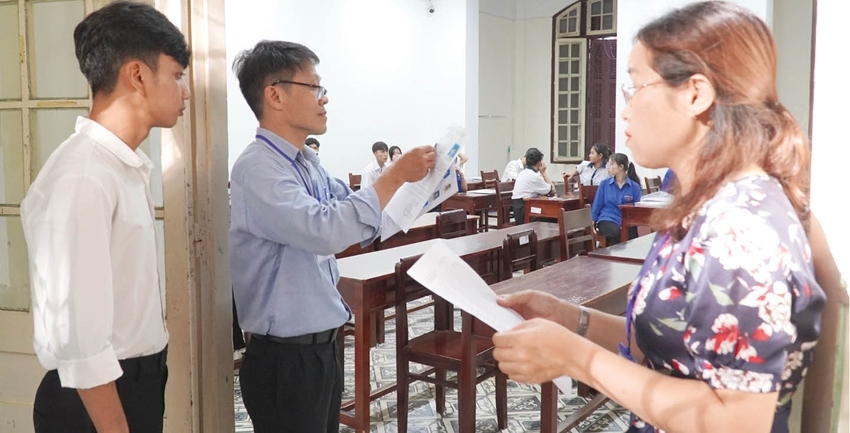
| The 2025 high school graduation exam was organized seriously and strictly in Hue |
Impression from the national exam
Right after the Ministry of Education and Training (MOET) announced the score distribution of the 2025 high school graduation exam, experts recognized positive changes from the quality of the exam questions to the results of students across the country. This year’s exam was evaluated to have a high level of differentiation, suitable for the goals of the new general education curriculum, and clearly reflected the real capabilities of students. The scores were not too low, reflecting the right perspective and target of the new general education curriculum.
The score distribution results also show that the exam successfully fulfilled its dual role: both serving as the basis for high school graduation assessment and providing reliable data for universities in their admissions process. According to statistics, there were 513 perfect scores in Math nationwide, 141 in English, 3,929 in Physics, 1,518 in History, 6,907 in Geography, and no perfect scores in Literature.
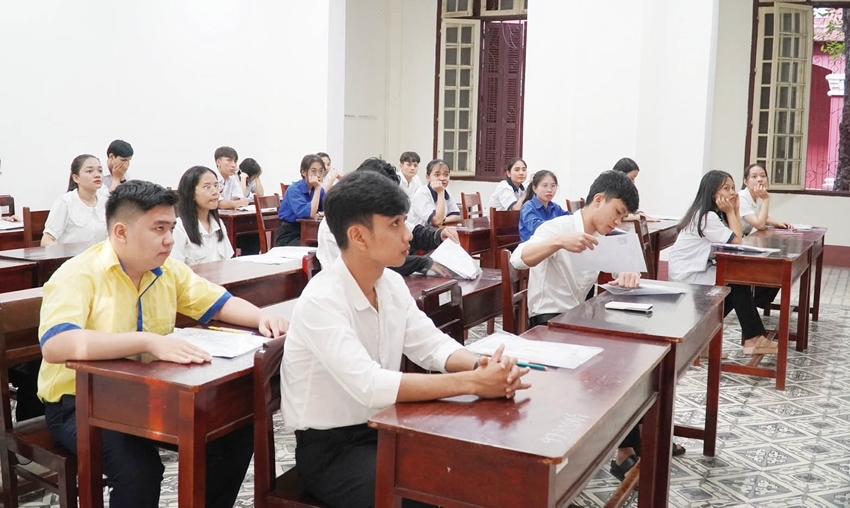 |
| Candidates participating in the 2025 high school graduation exam |
In Hue City, this year's graduation exam results are truly a memorable milestone. For the first time, Hue's score distribution ranked 9th out of 34 provinces and cities. Five of Hue's subjects were in the top 10 nationwide for highest average scores: Chemistry ranked 2nd (6.57 points); Literature (7.19), Geography (6.79), and Math (4.88) all ranked 7th; Physics ranked 9th with 7.14 points. Despite Math being considered difficult, the average score in Hue was 4.88, higher than the national average of 4.78.
Many students in Hue achieved perfect scores in various subjects. Physics had 73 perfect scores, Chemistry 14, Geography 62, History 7, Economics and Law 13, Math 4… This is a proud result, especially in the context that this is the first exam organized under the 2018 General Education Curriculum, with many new features in test item design. The increased score distribution also means the university admission rate will rise.
Results from the process of “real learning - real testing”
In 2022, Hue’s score distribution ranked 29th out of 63 provinces and cities; in 2023 it ranked 26th; in 2024 it was 25th; and this year it ranked 9th out of 34 provinces and cities.
To achieve that result, Hue City's education sector has gone through a long journey with persistent efforts, in which the core is the spirit of “real teaching - real learning - real quality” thoroughly conveyed from city leaders and implemented at every school. Mr. Nguyen Tan, Director of Hue City's Department of Education and Training affirmed: “The sharply increased score distribution and first time entering the top 10 nationwide is clear evidence of our commitment to the principle of real teaching - real learning. Hue's education sector does not chase achievements, does not teach to the test, does not skew focus, but focuses on improving real quality.”
For many years, the Department of Education and Training has focused on analyzing score distributions of exams to identify strengths and weaknesses, thereby proposing appropriate solutions. Subjects with low results received more professional support, especially in disadvantaged areas. “We brought excellent teachers to directly support remote schools; built a practical exam question bank; focused on tutoring weak students… All of this aimed to raise the overall quality evenly among localities,” Mr. Nguyen Tan shared.
Not only focusing on final-year students, the Department of Education and Training also implemented fundamental solutions from the lower secondary (junior high school) level. Over the past 3 years, the high school entrance exam for 10th grade has been applied citywide, instead of only in former Hue City schools as before. The entrance assessment combines academic performance from lower secondary education and entrance exam results in three subjects: Math, Literature, and Foreign Language, with a 70 - 30 ratio. This approach forced junior high schools to improve teaching quality from grade 6 onward, and students were also motivated to study all subjects equally, not just the core ones. This is an important factor helping maintain sustainable educational quality and gradually improve score distribution in the high school graduation exam.
The new general education curriculum, despite many difficulties, has been adapted and flexibly applied by schools. Students are encouraged to research independently, develop critical thinking skills, and apply knowledge to real life instead of rote memorization. These innovations were clearly reflected in how students handled exam questions, no longer relying on rigid templates or textbook examples but demonstrating independent and creative thinking.
Periodic assessments in schools were conducted with unified tests and evaluations to ensure consistency and synchronization, while also preventing negative behaviors in extra teaching and tutoring, ensuring fairness in student assessment and creating motivation for learning and professional development among staff.
According to Mr. Nguyen Tan, the results achieved come not only from individual student efforts, but are the culmination of a synchronized educational system: from the correct direction of the sector, the persistence of the teaching staff, to the support of parents and the whole society.
Looking at this year's score distribution, it can be seen that Hue City is on the right path in its journey to improve comprehensive educational quality. Without clinging to sudden achievement spikes, Hue chooses a slow but steady path, with the belief that real quality is the solid foundation for the future of the younger generation.