



 |
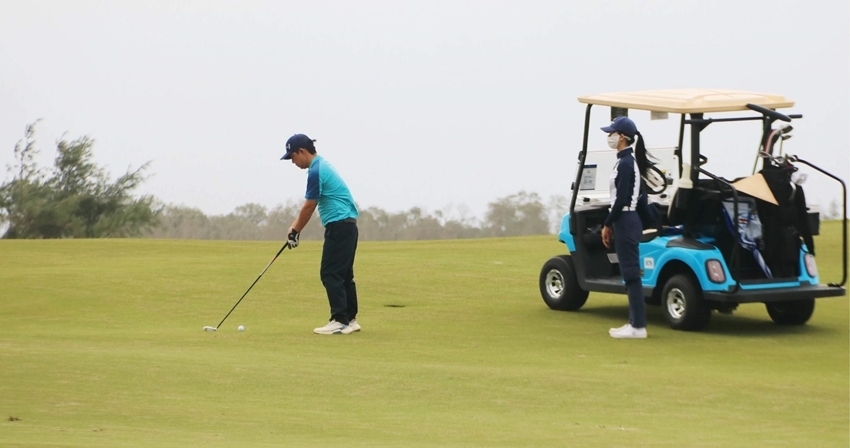
| Golfers at Golden Sands Golf Resort |
The attraction has yet to be strong
Over the past decade, golf tourism has emerged as a promising sector, helping to put Vietnam on the global golf map. The S-shaped country has been named “Asia’s Best Golf Destination” by the World Golf Awards for six consecutive years (2017–2022), thanks to its world-class golf courses and stunning natural landscapes. Among the highly rated golf courses, Hue currently boasts the Laguna Lang Co Golf Club and the newly established Golden Sands Golf Resort.
At a Hue Tourism Promotion Conference in South Korea on May 30th, Mr. Lee Jin Seok, Chairman of the Korean Travel Association, noted that besides competitive advantages such as culture, heritage, and the arts, Hue also featured beautiful golf courses – a perfect match for the travel preferences of Korean tourists, who are particularly fond of golf tourism. This presents a promising opportunity to attract Korean visitors to Hue.
Despite positive feedback on its golf courses, Hue’s golf tourism footprint remains unclear. Mr. Dinh Manh Thang, Vice Chairman of the Vietnam Tourism Association and Chairman of the Hue Tourism Association, shared that visitors from South Korea, Japan, Taiwan (China), and several other countries exhibited strong demand for golf tourism. South Korea, in particular, is one of the top generating regions for Vietnam, and its travelers are willing to spend generously when combining travel with golf. However, destinations like Da Nang, Nha Trang, Phu Quoc, and Lam Dong are currently outperforming Hue in attracting golf tourists.
Mr. Thang pointed out that at a golf course operated by BRG Group in Da Nang, there were around 500 rounds of golf played daily on average, while the number in Hue was only about 51. Notably, two-thirds of golfers in Da Nang are international visitors.
There are several reasons why Hue has yet to become a major golf tourism destination. According to experts, Hue currently has only two golf courses - insufficient to create a strong stimulus effect. Golfers typically prefer to play at 2–3 different courses during one trip and often return for repeat visits, but transportation between courses in Hue is still limited. In contrast, neighboring provinces like Da Nang offer more flexible and convenient connectivity. “We’ve tried connecting travel businesses between Hue and Da Nang, but linking them to bring in golf tourists still faces many barriers. Da Nang and Quang Nam can fully meet customer demands, while bringing tourists to Hue remains challenging - not only due to cost, but also other factors. Hue’s accommodation options also fall short of meeting the diverse and high-end needs of tourists,” explained Mr. Thang.
Beyond the golf courses themselves, supplementary tourism products in Hue still fail to meet visitor expectations. Experts emphasize that golf tourism is not just about playing golf. Many travelers want to play golf in the morning, relax at noon, swim in the afternoon, and enjoy nightlife in the evening. For high-end travelers, services and products must match their luxury expectations - something Hue currently lacks.
Collaboration to enhance the appeal
After the COVID-19 pandemic, travelers’ mindsets and behaviors have noticeably changed. They now prefer traveling in smaller groups with family or friends rather than large tours. This requires destinations to restructure and diversify their products to cater to specific traveler segments. A representative from a tourism business offered an example: a family traveling to Vietnam might include a husband who wants to play golf, a wife interested in shopping, and children needing entertainment facilities. This necessitates investment in infrastructure, products, and services - and most importantly, collaboration to offer complete, all-in-one packages.
Since golf tourists rarely visit just one destination, research and development of complementary tourism offerings are essential. Hue already enjoys natural resources, cultural heritage, and cuisine advantages. Tourism product development has been ongoing for years, but for each type of visitor, offerings must be based on market demand - sell what customers need,” not “what we have.” Linking golf with wellness tourism, resorts, culinary experiences, or cultural exploration is a smart direction, as long as it aligns with trends and customer preferences. At the same time, marketing and promotion must be more professional and well-structured. Strategic alliances should also be established to stimulate demand and attract visitors.
This is a golden opportunity for Hue to develop a well-structured strategy connecting local tourism products with high-end golf tourism. To enhance its appeal and competitiveness, and to encourage tourists to choose Hue as a golf destination, the city must ensure quality across the board - from air services and accommodations to cultural sites and gastronomy. All stakeholders need to come together to research and develop suitable products. Each party might consider sacrificing some short-term profits to offer attractive pricing that sparks tourists’ interest in experiencing Hue.