



 |
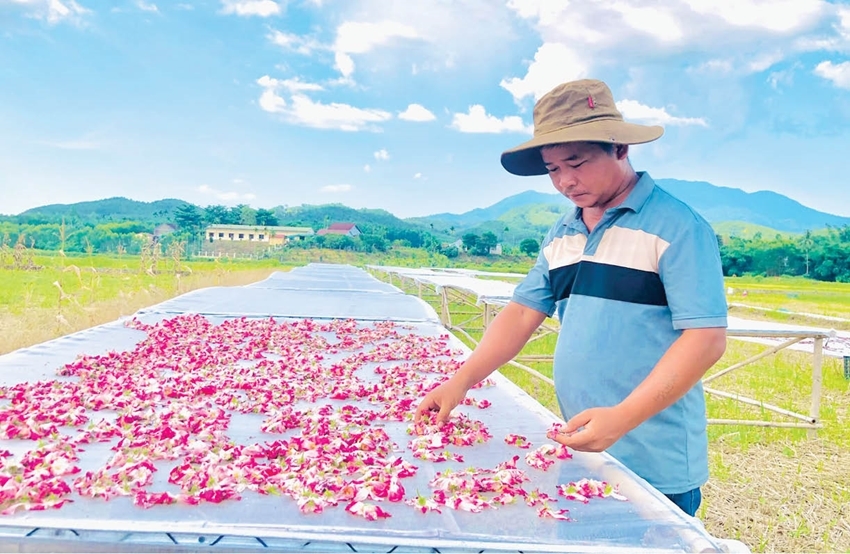
| Bo Chinh ginseng flowers are sun-dried for one day before being purchased by customers |
The early sunlight casts a golden color over the fields of Huong Phu commune, a place once considered difficult to cultivate during the dry summer days. Now, it is filled with the vibrant red of blooming Bo Chinh ginseng flowers. “Bo Chinh ginseng is a demanding crop that requires special care. Cold weather or prolonged rain can easily damage the plants. To prevent fungal diseases and root rot caused by changing weather, I have to monitor the weather closely to take timely preventive measures,” Toan shared.
Before “falling in love” with ginseng, Toan spent many years growing flowers and vegetables in Da Lat, where he received formal training from large-scale garden owners. Returning to his hometown to start a business, he chose chrysanthemums as his main economic crop. On Tet holiday, his 10-hectare chrysanthemum garden burst into brilliant yellow blooms, bringing a stable income for his family. He did not only produce flowers for Tet, but he also proactively staggered planting cycles so that his garden could have blooming flowers ready for the market on the full month and first days of the lunar month.
A few years ago, Storm No. 6 swept through and destroyed two of Toan family’s net-houses used for growing chrysanthemums, causing damages with nearly half a billion VND. That setback forced him to seek a new direction. Realizing that Bo Chinh ginseng was well-suited to the local soil and had a stable market thanks to a partnership with Hoang Gia Company, he boldly switched crops. From just a few hectares of trial planting at first, Toan has now expanded to nearly 3 hectares, becoming one of the pioneers in bringing Bo Chinh ginseng to the highland region of Nam Dong (now part of Phu Loc district).
Toan shared that one Bo Chinh ginseng crop lasts about 9 months. Around 3 months after planting, the plants begin to flower. Each early morning, about 10 workers head to the fields to harvest the flowers before the sun gets too intense, as excessive heat can cause the flowers to fade in color and lose medicinal value. During peak blooming season, the workforce doubles, sometimes up to 20 people a day are needed. On average, his ginseng garden yields about 300 kilograms of fresh flowers each morning. After being sun-dried for a day, the flowers are delivered to purchasing partners. In a good season, one hectare of ginseng can bring in revenue of 45 to 50 million VND.
Having gained substantial experience through trial planting and model expansion, Toan has gradually become a key figure in transferring Bo Chinh ginseng cultivation techniques to neighboring communes. His ginseng garden is not only a production site but also a model farm that attracts farmers from both inside and outside the district to visit and learn. Some localities, such as Huong Son and Thach Ha (Ha Tinh) have invited him to provide on-site technical consulting, offering up to 45 million VND per trip. However, due to his busy work on the farm, he has chosen to offer free guidance via phone calls and by recording videos to show farmers how to identify pests, diseases, mold, and other common issues.
According to Toan, Bo Chinh ginseng still has no specific treatment once it gets diseased, so prevention plays a crucial role. “Just a few days of negligence can result in losing the entire field. Regularly checking the weather, inspecting the garden, and closely observing each planting row are tasks that cannot be overlooked,” said he.
After a time of growing Bo Chinh ginseng, this kind of plants not only improves Toan family’s economic situation but also creates jobs for local workers. Meanwhile, Toan also spreads a message of hope that with enough effort, even on barren land, demanding yet high-potential crops can still bloom and bear fruit. His dedication has been recognized with a certificate of merit from the district Famer Association and commendation from the commune People’s Committee.